/*------------ MBT Image Opacity--------------*/ .Fadein img { filter:alpha(opacity=100); -moz-opacity: 1.0; opacity: 1.0; border:0; } .Fadein:hover img { filter:alpha(opacity=30); -moz-opacity: 0.30; opacity: 0.30; border:0; }
Showing posts with label Electric Vehicle. Show all posts

Tuesday, November 29, 2022

Electric or Gas? Key Considerations When Deciding What Car To Buy


When you're in the market for a new car, one of the primary decisions to make is buying an electric or gas-powered model. Both have their pros and cons, and it can be tough to determine which option is best for you. In this blog post, Liberty Buick GMC explores some of the key considerations when choosing between an electric and gas-powered car. 

Electric vs Gas Cars: The Basics

First, let’s go over the essential differences between electric and gas vehicles:


  • Electric cars are powered by electricity from batteries, while gas cars run on gasoline.
  • Electric cars are typically more expensive than gas ones but are also more efficient. That means you'll save money on fuel in the long run.
  • Electric cars emit no emissions, so they're better for the environment. Gas cars produce emissions that contribute to air pollution and climate change.
  • Electric cars have a shorter range than gas cars, so you'll need to plan your trips carefully. Gas cars can travel much further on a single tank of gasoline.


Both electric and gas cars have their pros and cons, so it's crucial to choose the right one for your needs.

Pros of Electric Cars 

Electric cars are becoming increasingly popular, and it’s not hard to see why. They’re environmentally friendly, they’re cheaper to operate than gas cars, and they’re fun to drive. But there are some other benefits of electric cars that you may not be aware of. 


For instance, electric cars don’t have any emissions, so they don’t contribute to air pollution. They’re also very quiet, allowing you to enjoy a quieter ride. And since electric cars don’t have any fluids that need to be constantly replenished, they’re much easier to maintain than gas cars.

Cons of Electric Cars 

Although electric cars have many benefits, there are also some drawbacks to consider. One of the biggest disadvantages is the initial cost of the car. Electric cars can be much more expensive than traditional gas cars, making them out of reach for many buyers. 


It’s also worth considering that electric cars require a dedicated charging station, which can add to the overall cost. Another downside to electric cars is their range. Unlike gas cars, which can be refueled quickly and easily, electric cars can take hours to charge, and may only have a range of a few hundred miles. This can be problematic for long-distance travel or for people who live in rural areas with limited access to charging stations. 


Finally, electric cars can put a strain on the electrical grid. Although this is not typically a problem in well-developed countries, it can be an issue in places with less reliable power sources.

Gas Engines vs. Electric Motors 

Despite the growth of electric vehicles, a large number of car buyers still want the power and sound that comes from gas engines. Many people enjoy the experience of stepping on the gas pedal and feeling the power of the engine. This is especially the case with pickup trucks and muscle cars, where the engine's roar is an essential part of the car’s character. Not only does it provide a thrill, it also serves as a warning to other drivers that they are in for a wild ride.


The sound of a gas engine gives enthusiasts something to be proud of and other drivers something to respect. It’s the sound of power and performance that can’t be matched with electric vehicles. With the rise in popularity of electric cars, some drivers are worried that the unique sound of a gas engine will become less common on the roads. But fortunately for them, many car companies are looking to maintain the sound of their engines while making them more environmentally friendly.

Charging Stations and Infrastructure

The advent of electric vehicles has created a new demand for charging stations and infrastructure. While there are many different types of chargers on the market, most public charging stations use Level 2 chargers, which can charge a vehicle in three to six hours. Level 3 chargers, also known as DC fast chargers, can charge a vehicle in 30-60 minutes but are not as widely available. 


To support the growing number of electric vehicles, having a robust charger infrastructure in place is crucial. This includes both public and private charging stations, as well as home chargers for those who have access to off-street parking.


Congress recently passed a bill that allocates $5 billion in funding (over five years) to states to build up their EV charging infrastructure. Each state will undoubtedly distribute its shares differently, but the ultimate goal of the bill is for there to be EV chargers every 50 miles. And as home chargers improve by the year, now could be an excellent time to invest in an electric car. 


Conclusion


When it comes time to make a decision about what car to buy, there are many factors to consider. Some people might be swayed by the environmental benefits of electric cars, others might prefer the convenience of gas-powered vehicles. No matter which side of the debate you come down on, Liberty Buick GMC is here to help. We can connect you with our experts who can walk you through all your options and help you find the perfect vehicle for your needs. Electric or gas? The choice is yours!

Author:  Alex Watson, CCP Web Design Writer


Tuesday, April 20, 2021

What to Expect from the Upcoming GMC Hummer EV SUV (and How to Reserve Yours)

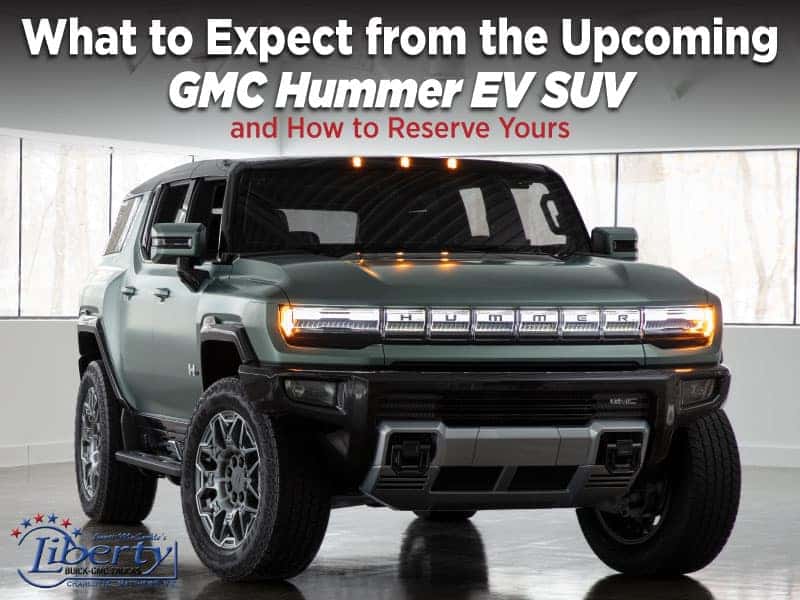
 GMC Hummer EV SUV

In 2020, it’s almost as if automakers banded together to provide some hope to fans of classic off-road vehicles—something positive in a year that would prove difficult for so many people for a variety of reasons. Surely, that’s why we’ve seen the reemergence of several legendary 4x4 nameplates, right?

Or, it could simply be that automakers are not going to let their competitors one-up them (admittedly, this is the most likely reason). Whatever the case, here we are in 2021, and we’ve learned that one of the most anticipated vehicles in recent memory is set to hit dealerships in early 2023: the GMC Hummer EV SUV. If you thought the Humvees of old were tough, well, it’s safe to say that this new era will not disappoint. 

GMC is accepting reservations for its new creation, and there are no strings attached. All you have to do is register for your preferred trim and pay a fully refundable $100 deposit. That’s right—registering puts you under no obligation to actually buy the vehicle, but it will hold your spot in line. Whether you’re dead-set on purchasing the GMC Hummer EV SUV or are just a spectator, there’s really no downside to making a reservation. 

Liberty Buick GMC is here with the skinny on what consumers can look forward to from the 2024 Hummer EV SUV, as well as some details about the registration process:


GMC Hummer EV SUV Trims

As with the pickup version, the GMC Hummer EV SUV is set to offer four trims over the first several years of its release, all varying in features and price: the Edition 1, 3X, 2X, and 2. Here’s the gist of what we know about each model:


Hummer EV Edition 1

The first trim of Hummer EV SUVs is called the “Edition 1.” It is set to roll into dealerships in early 2023 as a 2024 model, and it will be the fully-loaded version of the SUV. 

While this run of special editions is limited, GMC has not articulated exactly how many will be available. We do know that reservations for the Edition 1 are full, but consumers can still get on the waitlist, which could come in handy if a considerable number of reserved consumers back out or if the automaker decides to raise the ceiling on production. 

For the initial launch, the GMC Hummer EV SUV Edition 1 will come in Moonshot Green Matte exterior paint with black above the beltline. The grille consists of a crystal light that displays “HUMMER,” and there are several “H” graphics sprinkled around the SUV. As far as power goes, you can expect up to 830 horsepower and a 0-60 mph of 3.0 seconds. The first available model will be an on-road edition that includes 22-inch premium wheels, assist steps, special badging, and floor liners. The price is $105,595, which is $7,000 less than the Edition 1 of its pickup truck sibling. 

Buyers who want the off-road package will need to spare $5,000 more, and in return, will get 18-inch wheels with 35-inch tires, underbody armor, heavy-duty half shafts, rock sliders, and a front eLocker and virtual rear lockers. Even bigger tires (37-inch) will be an option from dealers. 


Other Trims

The Hummer EV SUV 3X and 2X models are expected to arrive at dealerships in Spring 2023. The former still offers three electric motors and starts at $99,995. The latter is equipped with two motors, is estimated at 625 hp and a 0-60 mph of 4.0 seconds, and comes with a starting price of $89,995. The base two-motor Hummer EV SUV (the EV2) is anticipated for a release in spring 2024 at $79,995. It provides the same power as the 2X, though the range on a single charge falls from 300 to 250 miles. This model uses 400-volt fast charging, but you can opt for 800 volts, which is what all other Hummer EV SUV models come with. 


How to Reserve Your Hummer EV SUV

If you’re sold on getting a 2024 GMC Hummer EV SUV, or even if you’re still, on the fence, it’s easy to reserve your spot. Simply log on to the GMC Hummer EV microsite and follow these four steps: 

1. Pick a Trim 

2. Select a Dealer 

3. Fill Out Your Information

4. Sign a Registration Agreement

Keep in mind the release dates when choosing a trim, as there will be more models and colors released over time. Any participating GMC dealer is viable for selection, and Liberty Buick GMC is here for you! Once you complete the registration online and receive a confirmation email, we will contact you to complete your purchase order. 

Remember—all reservations are refundable. As long as you reach out to your dealer and request a refund before your purchase order is submitted, you will get your $100 back. 


Conclusion

The upcoming Hummer EV SUV is primed to meet—if not exceed—all expectations. If you can budget for the price and wait time, then you can get your hands on the reborn legend in a couple of years. Don’t forget to make your reservation now, and give us a call at Liberty Buick GMC to finish your order!

Monday, March 29, 2021

General Motors Doubles Down on All-Electric Future

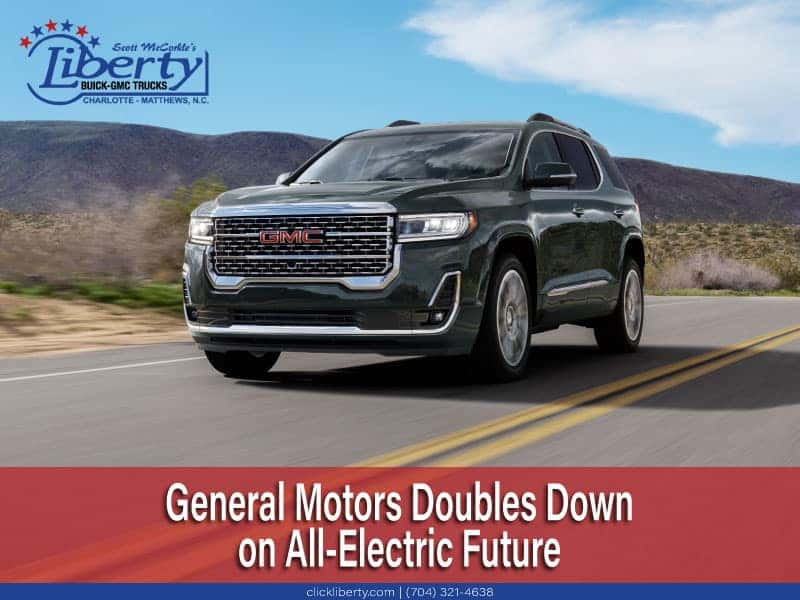
 GM All Electric Vehicle in Charlotte NC

General Motors has made no secret about its plans for electric vehicles in the future. For several years, the auto manufacturer has released EV concepts and information for its four primary brands: GMC, Buick, Chevrolet, and Cadillac. 

Those plans have only strengthened in recent months. GM seems more convinced than ever that the future of the auto industry lies in all-electric vehicles that not only will benefit the environment but will ultimately cost less to drive. Part of the plan is to release 30 new EVs by the 2025 model year. Below, we’ll look at GM’s strategy.

GMC and Buick’s upcoming EVs.

30 EVs by 2025 

If there were any doubts about GM’s commitment to fighting climate change and raising the bar for the rest of the auto industry, those doubts were laid to rest in recent months. We now know that GM has big plans for electrification and is working hard to execute the plans within a relatively quick timeframe.

Before the COVID-19 pandemic hit, GM announced that it would invest $20 billion in electric and autonomous vehicles through 2025. That number has now changed to $27 billion. Not too long ago, the automaker had also said that it would be launching 20 new EVs by 2023, most of which would only be available for the China market, where there is a higher demand for EVs. However, GM recently announced a change of plans: It will release 30 EVs by 2025, and North Americans will have access to more than two-thirds of them. The GMC, Buick, Chevrolet, and Cadillac brands will all offer EVs. 

For GM, these plans stem from an overarching goal of becoming carbon-neutral by 2040. To accomplish this goal, the manufacturer will seek to cease production of all gasoline- and diesel-powered vehicles by 2035. GM also hopes to power all of its U.S. facilities with 100% renewable energy by 2030, along with its international facilities by 2035. 


Upcoming Buick/GMC EVs 

While there are many GM electric vehicles on the horizon, let’s take a quick look at some of the upcoming EVs from the GMC and Buick brands:

GMC

For decades, the Hummer models were known as being mean, gas-guzzling machines. After being discontinued in 2010, GM is resurrecting Hummer as a GMC sub-brand for the 2022 model year. We’ll see two forms of the all-new Hummer: a pickup truck (SUT) in 2022 and an SUV in 2023. Both models will be all-electric. And both models will be meaner than ever. 

Here’s what we know so far about the Hummer EV SUT:

  • It will offer up to 1,000 horsepower.
  • The powertrain will include up to three electric motors. 
  • The truck will go about 350 miles on a charge.
  • It will get you to 60 mph in just three seconds. 

It appears that the Hummer EV SUT will be a dream for off-road enthusiasts. It will showcase the “Crab Walk” mode, a four-wheel-drive feature that allows you to drive diagonally. Drivers will also have the option of an adjustable air suspension and removable roof panels. The 2022 GMC Hummer EV SUT is set for release in late 2021. 

Buick 

According to public knowledge, there are at least two Buick electric vehicles in the works (though several other concepts are circulating). The Buick brand is making significant strides in China, where demand for EVs is much higher due to stricter emission standards. As of now, it’s unclear whether Buick will release EVs in North America within the next couple of years or whether the EVs will debut in the China market and make their way to the States shortly after that. 

We do know that GM has unveiled the development of two electric SUVs. According to the automaker, one model will provide “more conventional crossover proportions.” Expect this SUV to be geared toward families with an emphasis on interior space and cargo. The other Buick all-electric SUV is being developed with “a greater emphasis on form and athletic fashion.” Along with more expressive proportions, this SUV is likely to cater more to single people and couples. 


Conclusion 

The future is electric. And no auto manufacturer is capitalizing on this prediction more than GM. By confidently setting ambitious goals for an all-electric lineup and carbon-neutral facilities, and by already taking actionable steps toward these goals, GM firmly establishes its place in the industry as a visionary automaker.

Only time will tell how the details of this master plan pan out. But it’s safe to say that the future is bright.